
Psalm 80
an exegesis by Mo Soup


Translation
0To the music director, to Lilies. A Testimony. A Psalm of Asaph.
1Shepherd of Israel, give ear! You who leads Joseph like the flock, You who sits between the cherubim, cause your light to shine forth!
2Before Ephraim, and Benjamin, and Manasseh, stir up your might and come to save us.
3God, turn us back, and cause your face to shine, and we will be saved.
4YHWH God of armies, how long will you be angry with the prayer of your people?
5You have fed them with the bread of tears and caused them to drink tears in great measure.
6You make us strife to our neighbors and our enemies laugh to themselves.
7God of armies, turn us back, and cause your face to shine, and we will be saved.
8A vine out of Egypt you pulled up. You drove out the nations and then planted it.
9You have cleared before it, and caused it to take deep root, and it filled the land.
10The mountains were covered with its shadow, and with its branches, the mighty cedars.
11It sent out its limbs to the Sea, and to the River, its shoots.
12Why have you broken down its hedges, so that all who pass by the way pluck its fruit?
13The boar of the forest ravages it, and the creepy-crawlies of the field devour it.
14God of armies, turn back please!
Look from heaven and see, and look over this vine,
15and the stalk which your right hand has planted, over the branch you have fastened to yourself.
16It is burnt with fire like refuse. At the rebuke of Your face may they perish.
17May your hand be on the man of your right hand, on the son of man you have fastened to yourself.
18Then we will not turn back from you. Revive us, then on your name we will call.
19YHWH God of armies, turn us back, and cause your face to shine, and we will be saved.
Introduction
Psalm 80 has it all: significant position in the macrostructure, Hebrew wordplay, beautiful imagery, Messianic prophecy, literary structures, and unfulfilled requests. Without personal study, the psalm could easily remain an enigma, but study produces great fruit. Psalm 80 is relevant and valuable for the covenant community to sing today, for it requests God to continue fulfilling His covenant promises to the Church in these last days.
This paper will consist of nine parts: (1) Authorship, (2) Date of Publication, (3) Covenantal Context, (4) Literary Context, (5) Textual Outline, (6) Verse Analysis, (7) Covenantal Ecclesiology, (8) Messiahship, and (9) Homily.
Authorship
The introduction to the psalm, in both the Hebrew text and the Septuagint, ascribes authorship to Asaph. Besides Ps. 50, all the psalms of Asaph are collected within psalms 73-83. Asaph first appears in 1 Chron. 16 under assignment of David to “give thanks to the LORD (16:7).”[1] David, “left Asaph and his relatives there before the ark of the covenant of the Lord (16:37a).” The authorship label “Asaph” likely includes those relatives, as 1 Chron. 25:1-6 adds that the “sons of Asaph” were part of this duty while Asaph particularly was under the direction of the king. Asaph or “the sons of Asaph” are also mentioned in 2 Chronicles at the consecration of the temple by Solomon (5:12), the temple form of Josiah (29:13), and the temple reform of Hezekiah (35:15).
Asaph is described as a seer, and his sons also take up the mantle in this prophetic role. This prophetic family is mostly concerned with music, but in one circumstance (2 Chron. 20:14), a descendant of Asaph prophesies in the assembly of Judah by “the Spirit of the LORD.” Asaph and his relatives had a specific job description. They were, “to minister before the ark continually, as every day’s work required (16:37b).” Unsurprisingly, the name Asaph is important in the narrative of the ark being brought to Solomon’s temple and the temple reforms of Josiah and Hezekiah. Fittingly, Ps. 80 carries distinctive ark imagery.
Ezra 2:41 and Neh. 7:44 record a return of “the sons of Asaph.” In Ezra 3:10, “the sons of Asaph were present at the laying of the foundation of the new temple to lead in musical praise. Nehemiah 11:17, 11:22, 12:35, and 12:46 all reference the historic and continuing role of Asaph in temple worship. Although the “sons of Korah” are attributed as authors, it is not unreasonable to assume that those songs attributed to Asaph may be authored by his sons and attributed to the name of their genealogical musical guild. Therefore, the date of this psalm could extend from the time of David to the days of Ezra and Nehemiah when the psalter was organized.
Harry Nasuti, a critical scholar and Roman Catholic, applies the Documentary Hypothesis to the psalter, assuming a particular tradition history with the acclaimed “Elohistic” psalms (42-83). Nasuti concludes that the Asaphite psalms are of an Ephraimite tradition, agreeing with critical scholars Hermann Gunkel and Otto Eissfeldt that Ps. 80 is authored by the cultic Ephraimite tradition in the north.[2] Not only is this critical tradition history a faulty exegetical starting point, but the Bible locates the Asaphites beside the altar in the city of Jerusalem, not in the north. It is true that the Gershonites, from which Asaph came, were allotted cities in the north, but Asaph and his family are clearly considered to be residing in close proximity to the ark.
This vein of critical scholarship continues in the writing of Michael Goulder a decade later. Goulder, a critical scholar and Anglican apostate, says, “While it would be rash (and erroneous) to dismiss the Chronicler’s traditions about Asaph as valueless, they certainly cannot be accepted uncritically.”[3] This unfortunate view of Scripture undermines the ability to truly discern the author and date of this psalm. As Scripture is the infallible guide in exegesis, it can be asserted that Asaph and his relatives, as appointed to this task by David, are the authors and publishers of this psalm.
Date of Publication
There is no certainty concerning the date this psalm was published, but there are clues that allow for a reasonable guess. It could be argued that this psalm was written in response to the fall of Judah which signified a total destruction of all Israel, but the introduction suggests that there is still a temple which allows for the psalm to be given “to the music director” (unlike Ps. 79).[4] The absence of the name “Judah” in this psalm is striking, leading commentators to agree that it concerns the northern kingdom of Israel.
Although not inspired, the Septuagint does indicatively state in the introduction that Ps. 80 is ὑπὲρ τοῦ Ἀσσυρίου (concerning the Assyrian). The historical writings and prophets corroborate the conclusion of the authors of the Septuagint, since the destruction of Samaria by the Assyrian(s) is the central mass destruction prophesied and accounted in Scripture. Although 722 BC is considered to be the culmination of the ravaging of the Assyrians, Israel had already underwent years of devastation at the hand of Israel. King Tiglath Peleser raided Israel during the days of Pekah (2 Kings 15:29). Later, Samaria was besieged for three years by King Shalmaneser until taken in Hoshea’s ninth year (2 Kings 17:5-6) and then other nations were brought into the land (17:24).
Because of the devastation that occurred before 722 BC, some argue that this psalm was published before the fall of Samaria, but they often assume that a northerner is the author crying for help.[5] In opposition, Allen Ross, Marvin Tate, and Christopher Ash, in their commentaries, agree that the psalm was most likely published between 722 BC and 586 BC, particularly during the reforms of Hezekiah or Josiah.[6] It is reasonable to think that this psalm was published during or following a time of temple reform (when the Scriptures attest that the Asaphites were actively serving).
Perhaps the greatest clue in determining the date of publication comes from 2 Chron. 30. In his reform, Hezekiah sent word to all Israel and Judah inviting them to come worship at the Passover. Couriers read Hezekiah’s statement which said, “People of Israel, return to the Lord, the God of Abraham, Isaac and Israel, that he may return to you who are left, who have escaped from the hand of the kings of Assyria. . . . He will not turn his face from you if you return to him (v6-9).” Comparison between this edict and Ps. 80 uncovers clear allusions (Israel, face of God, returning, land, Assyria, etc.) supporting the idea that Ps. 80 was written during or following Hezekiah’s reform. Perhaps the literature of this decree became a common refrain within Judah in reference to God’s dealings with Israel and was adopted into Ps. 80.
It appears that Hezekiah’s first Passover occurred in the first year of Hezekiah’s rule (2 Chron. 29:3-30:1), meaning that the decree was made prior to the siege of Samaria in Hezekiah’s third year and the final downfall in Hezekiah’s sixth year (2 Kings 17:5-6). Perhaps Ps. 80 could be dated as early as this decree for Passover (~728 BC), considering that Israel was already nearly destroyed by Assyrian kings such as Tiglath Pileser (2 Kings 15:29) and Shalmaneser (2 Kings 17:3-4), but Ps. 80 inescapably describes a total destruction (despite a remnant of hope). Therefore, it is most likely that Ps. 80 was published after 722 BC during the reign of Hezekiah, though it could have been published after the reign of Hezekiah, before 586 BC.
The use of the first-person plural in Ps. 80 appears to deny “total destruction” since a congregation is asking God for their own restoration. Yet, the third person plural is used in v.5. The author maintains the perspective of an onlooker, while also identifying with the vine of Israel. There may also be a measure of distinction between vs.4-5 and v.6, since vs.4-5 discuss “them” and v.6 discusses “us.” These differing perspectives of the author are explainable. While he associates with the suffering of Israel and makes His request as a member of Israel, he is not a member of the northern kingdom. Instead, as a member of the southern tribe of Judah, he is a remnant of Israel. Vos, in his Eschatology of the Psalter, says, “in certain cases the collective speaker is not the external, ethnical Israel, but the people conceived as to its ideal . . . the church within the church.”[7] Asaph speaks for Judah simultaneously as an onlooker of the devastations in Israel and as a member of Israel.
Covenantal Context
The original declaration of the promise of the covenant of grace in Gen. 3:15 assumed that suffering would precede exaltation. The Book of the Covenant maintains this theme of humiliation and exaltation as it records God’s covenantal dealings with His covenant people. Ps. 80 is an outcry, not an outcry of surprise, but yet a prayerful outcry for God to be faithful to His covenant. As predicted (Hos. 1:6; Isa. 7:1-8:10), the faithless covenant people of Israel have been judged for their transgression of the covenant (Hos. 6:7). What may not be surprising for the remnant of Israel, is still shocking for them to view and swallow. Moses predicted these things in his song to the assembly of Israel in Deut. 32, but not without a promise of hope for the final blessing of Israel (Deut. 32:42-43; 33:26-29).
Ps. 80 is the response of the remnant of the covenant community to the terrible judgment which God brought upon the rest of Israel. Sons and daughters of Israel were taken captive. The promised land was taken captive. The blessings of God were replaced by the wrath of God. The blessed were now rejected: the tent of Joseph, Ephraim his chosen son, Benjamin that produced Saul, and Manasseh the firstborn of Joseph. Worst of all, the psalm implies that God’s face is no longer shining towards His people.
This psalm does not call the covenant of God into question impudently, but with a righteous request based and cushioned upon the past redemptive acts of God. The psalmist recounts the Exodus with in-depth imagery. Here God’s people were led by the ark of the covenant out of captivity from Egypt. Like a vine they were plucked up from Egypt, re-planted, and then nourished under God’s blessing. But now the vine has been cut down. God’s promises are clearly unfulfilled following the devastation of 722 BC, but the remnant in Judah recounts God’s past wonderful works with hope that He will carry His Israel out of captivity in a future wonderful work.
Before the final refrain, Ps. 80 presents a Messianic promise. A son will come to replace the branch of Israel. This Son will not simply be the Redeemer of Judah, but the Renewer of all Israel. This Messianic figure will be the means by which the personal “YWHW God of armies” again gathers his army to Himself out of captivity as a renewed vine of Israel. As God’s covenant faithfulness is brought into question, the Messiah enters the scene to assure the congregation that He will fulfill the promises of God.
Psalm 80 prepares the way for the New Covenant. The Messiah will revive the vine of Israel and ingraft Gentiles branches to the plant. The true spiritual Israel will not only be more expansive, but it will not “turn back” from God.
Literary Context
Psalm 80 is located in the central book of the psalter. Book III is considered the darkest book of the psalter, recounting the dark events which seem to undo the redemptive works of God. This book includes Ps. 88, the only psalm to exclude any clear message of hope in its conclusion. The book ends (Ps. 89) with some hope despite the image of the Davidic crown cast into the dust. Within the macro-structure of the psalter, Book III is the book of humiliation which precedes the exaltation to come (as found at the end of the fifth book).
Walter Kaiser affirms a common belief that there are numerous specific events of devastation recounted in Book III:
Babylon’s invasion of Judah in 596 BC – Psalm 74
Assyria’s Invasion of Judah in 701 BC – Psalm 76
Philistine invasion of Judah in 1060 BC – Psalm 78:60-64
Babylonian invasion of Jerusalem in 586 BC –Psalm 79
Assyria’s invasion of Samaria in 722 BC – Psalm 80[8]
While some songs concern the north, and others the south, Book III focuses on the judgments of the people of God.
Psalm 80 appears to fall at the heart of the psalter and this central book. Interestingly, the Masoretes took note that the aleph in מִיָּ֑עַר (v.13) is the middlemost letter in the whole Hebrew Psalter. Although this interesting note may not have any certain theological implications, Ps. 80 is also in a notable position within the third book of the psalter. O. Palmer Robertson argues that there is a grouping of seven psalms within the center of this book (77-83), of which Ps. 80 is the pinnacle point.[9] Although this structure cannot be proven here, it is worth considering.
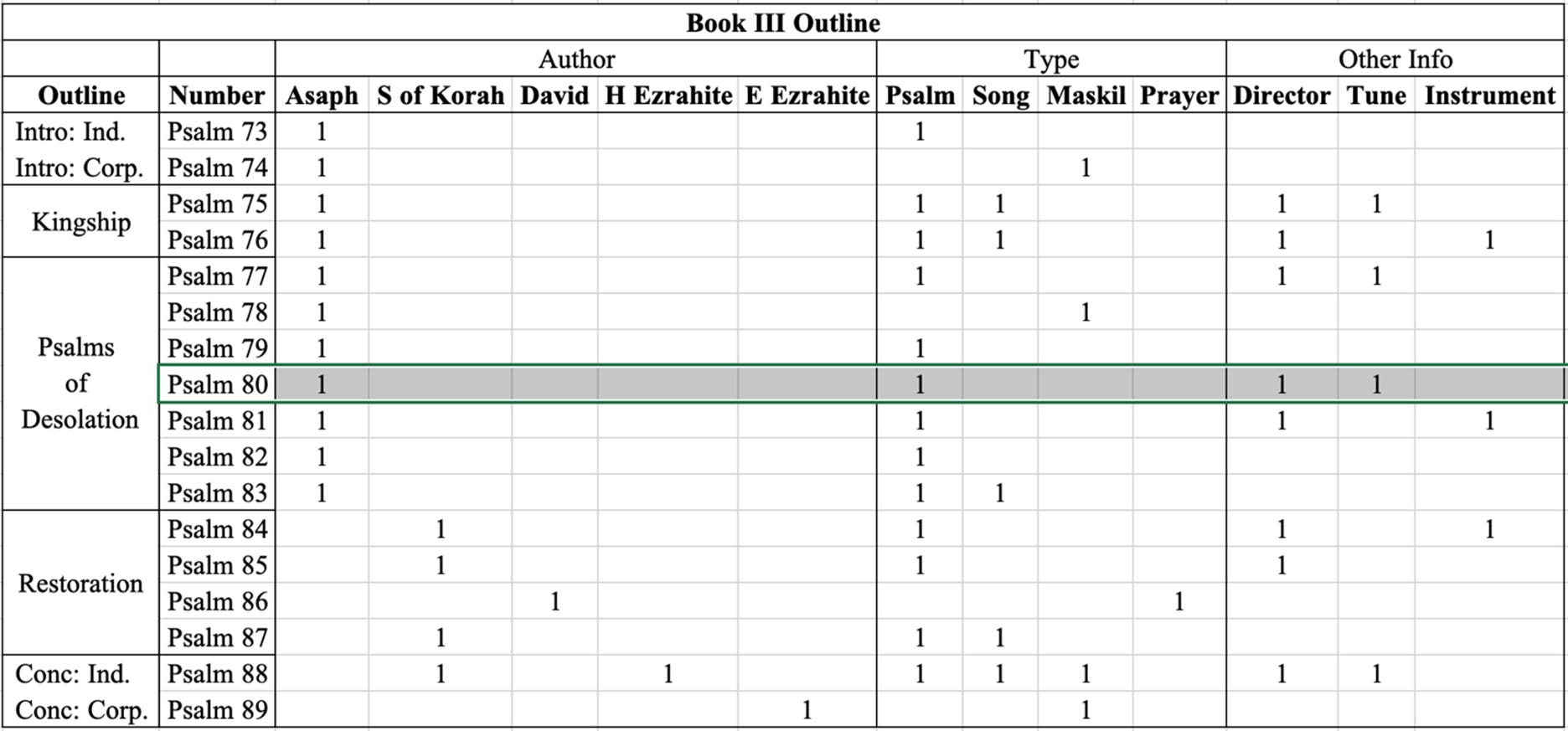
Psalms 77-79 prepare the way for Ps. 80. Psalm 77 remembers the wonderful works of God, particularly in the Exodus. It notes that God has redeemed “Jacob and Joseph” and concludes with the statement, “You led your people like a flock.” Psalm 78 also notes God’s wonderful works, mentions Jacob and Israel, and then discusses God’s role and the role of Moses as a Shepherd in the Exodus. Psalm 78 says in its last strophe, “He also rejected the tent of Joseph, And did not choose the tribe of Ephraim. But chose the tribe of Judah (v.67-68a).” David is then represented as the Shepherd from Judah who shepherded both “Jacob His people, And Israel His inheritance (v.71b).”
Psalm 77 and 78 prepare the way for a psalm concerning the southern kingdom, and a psalm concerning the northern kingdom: both of which describe the devastations of Israel as a whole. Psalm 79 concludes with the statement, “we . . . the sheep of your pasture.” Both Judah (Ps. 79) and Israel (Ps. 80) consider God as their Shepherd, but it is Ephraim and Joseph that are rejected. Yet, the Messianic imagery in Ps. 78 concerning David assures the reader that the Son (of David), who arrives in Ps. 80, will Shepherd both Jacob and Israel. Yes, the rejection of the northern kingdom is sure; the Messiah will come from Judah, but the Messiah will Shepherd all of Israel. Further, there is a clear linear progression in the shepherd theme: Moses is shepherd (77), then David is shepherd (78), the exile occurs (79), and then the Messiah is the Shepherd (80).
It may be surprising to see that Ps. 79, which concerns the destruction of the temple in Jerusalem, is not the focus here. The events in 586 BC seem to deserve the spotlight over the events of 722 BC, but perhaps the Book of Lam. was sufficient to highlight this event. Interestingly though, the word הֲשִׁיבֵ֨נוּ which appears three times in the refrains of Ps. 80, appears only once more in the Hebrew Scriptures: in the concluding requests of Lamentations (5:21). The imperative verb asks, “turn us back to you.” The “us” in both Lamentations and Ps. 80 is not simply, Jacob, but all of Israel (Jer. 31:10; Isa. 11:11-12; Ezek. 11:17).
Therefore, it does not seem to be a coincidence that these two events are beside each other in this desolate section of the psalter. It may be that Ps. 80 builds upon the laments of Ps. 79 looking forward to the Messianic prophecy in which it ends. The return of the exiles from Judah is not a greater redemptive act than is the return of the exiles of Israel. When the psalter was organized (likely by Ezra) after the exodus of Judah from Babylon, the “organizer” was aware that another greater exodus was to come for the whole of Israel at the hand of the Messianic Son of David. There is a clear linear progression in the shepherd theme: Moses is shepherd (77), then David is shepherd (78), the exile occurs (79), and then the Messiah is the shepherd (80).
Textual Outline
There are various suggestions for outlining this psalm. James Boice, Christopher Ash, and Ernst Hengstenberg, in their commentaries, all suggest three main sections or stanzas.[10] Some organize these three main stanzas by the refrain, but others see the first 7 verses as the intro and the main body of 12 verses divided into two sections of 6 verses. Keil & Delitszch, in their commentary, alternately suggest, “The Psalm consists of five eight-line strophes, of which the first, second, and fifth close with the refrain.”
Although there is no generally attested outline, all these outlines make helpful assertions. There are three basic stanzas with three basic themes (see outline). The first stanza serves as a general introduction to the psalm, with 7 verses split into 2 sections (of 3 and 4 verses). The latter two stanzas split 12 verses into two sections (6 verses each).
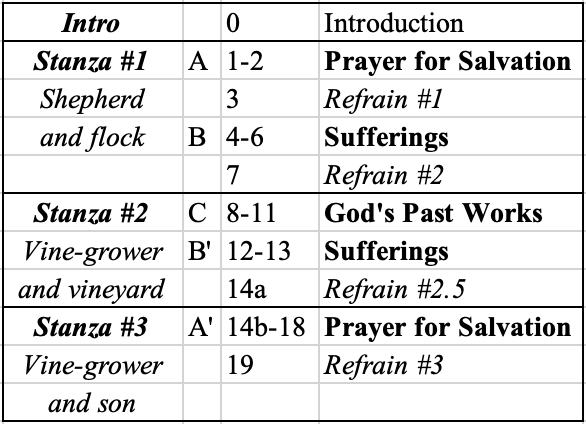
There are also five strophes with all but the middle strophe ending with a refrain. This middle strophe appears to be a central point of a chiastic structure, centering on God’s wonderful works, particularly in the Exodus storyline. It is this redemptive working of God which the psalm is requesting to occur again when it demands, “Restore us!”
Despite this central point in the chiastic structure, the theology and structure of this psalm is too complex to boil it down to a chiastic central point alone. It is also forward looking, and the whole structure of the psalm is building towards a greater more final hopeful request. Each of the three main refrains are the same except for one word added with each additional reading (“armies,” #2, and then “YHWH,” #3). It is refrain #2.5 that opens the conversation to the new manner by which God will “turn us back again/restore us”: He must turn back to them Himself. Refrain 2.5 differs from the other three main refrains, but cues the singer to see the Messianic character that arises to supply the method by which God will “restore.” This Messianic figure brings about a greater wonderful work in redemptive history than does the Exodus, and allows for a completed restoration (v18). The third and final refrain carries greater thrust than the first two, not only because it addresses the personal “YHWH,” but because the greater revelation that precedes this request supplies more tangible hope for the singer.
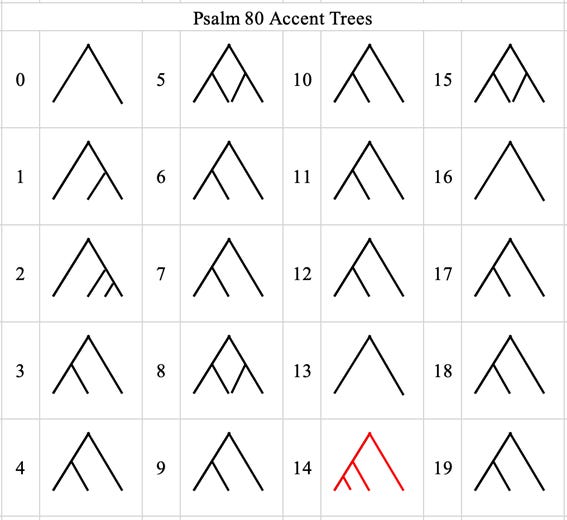
The verse analysis will note some points of interest in the Hebrew accentuation. Although no extensive psalm structure is visible in the accent trees, v.14 is a turning point in the psalm. Instead of using the atnach found in every other verse, the oleh weYored is used as a more powerful disjunctive to accentuate the words of refrain #2.5.
Verse Analysis
Verse 0 – לַמְנַצֵּ֥חַ אֶל־שֹׁשַׁנִּ֑ים עֵד֖וּת לְאָסָ֣ף מִזְמֹֽור׃
To the music director, – Though never found in Book IV, לַמְנַצֵּ֥חַ is a common note in psalm titles. This supervisor is not just the leader of the choir, but of all temple music. The following word is conjoined with a conjunctive accent, so a comma is placed after “director” instead of a period.
to “Lilies.” – Shushannim (שֹׁשַׁנִּ֑ים) is also located in the title of Psalm 45 and 69, but without the following word, עֵד֖וּת. Psalm 60 similarly has עֵד֖וּת, but these two words are conjoined by a munah, whereas Psalm 80 disjoins these two words with an atnach. Interestingly, Song. (2:16; 6:2-3) says, “He pastures his flock among the lilies.” Perhaps there is a correlation between “lilies” and God’s role as the Shepherd.
Hosea 14 may allude to Ps. 80. The chapter records the blessing God promises to give to Israel (idolatrous Ephraim) despite the oncoming attack of the Assyrians. God says, “He will blossom like the lily, And he will take root (14:5b).” Not only is the word “lily” present in both passages, but Ps. 80 discusses how God has and will help Israel “take root.”
A Testimony. – עֵד֖וּת is also found in the title of Psalm 60. Psalm 60 and 80 share similar tones of military defeat, and both ask for salvation from “your right hand.” עֵד֖וּת is a common word in Exodus and Numbers. It serves as a covenantal word (tablets, ark, and tabernacle of עֵד֖וּת). This title sets the stage for a psalm ripe with Exodus imagery, particularly concerning the “ark of עֵד֖וּת.”
A Psalm of Asaph. – See the discussion above.
Verse 1 – הַאֲזִ֗ינָה נֹהֵ֣ג כַּצֹּ֣אן יֹוסֵ֑ף יֹשֵׁ֖ב הַכְּרוּבִ֣ים הֹופִֽיעָה׃ רֹ֘עֵ֤ה יִשְׂרָאֵ֨ל
Shepherd of Israel, – Psalm 80 follows a theme found in the first three psalms of this seven-song grouping (77-83). Psalm 77 ends with Exodus imagery; “You led Your people like a flock, By the hand of Moses and Aaron.” Then Psalm 78:71-72 explains that God chose David out of the sheepfold to shepherd Israel. The singers of Psalm 79:13 then call themselves the sheep of God’s pasture. Psalm 80 then clearly identifies God as the Shepherd of Israel. In the Qal active participle (absolute form), רֹ֘עֵ֤ה literally reads as “the one Shepherding” Israel. Likely Jesus referenced this title when He said, “I am the good shepherd (John 10:14).”
give ear! – הַאֲזִ֗ינָה originates from the noun אֹזֶן (ear). The Hiphil imperative verb is causative, so it could read, “cause yourself to hear.”
You who leads Joseph like the flock, – The verb נֹהֵ֣ג is in the active predicative form: “you who leads.” The KJV perhaps captures the meaning of this verb by rendering it as “thou that leadest.” “Joseph” is chosen to represent Israel, particularly the northern kingdom (Ezek. 37; Amos 5:15). His name was probably chosen over other representative names, like Ephraim, because it is association with “Shepherd” in both Gen. 48:15 and Gen. 49:24. It is noteworthy that Joseph was a Messiah-type that suffered in exile, to be used by God to lead His chosen sheep out of devastation. Most translation do not represent the definite article (the), but it is present in the second dagesh forte found in כַּצֹּ֣אן. Therefore, Joseph, or Israel, is “the flock” of the “One Shepherding.” Ps. 80 strikingly lacks explicit Davidic imagery, but Joseph holds a special position in this part of the Psalter, with all five appearances in this book being Ps. 77, 78, 80, 81, and 105.
You who sits between the cherubim, – יֹשֵׁ֖ב is the same verb form as נֹהֵ֣ג in the last phrase. Although there is no preposition in the Hebrew, a preposition can reasonably be added for readability in English. There are varying opinions on what this preposition should be; ESV adds, “upon;” NASB, “above;” and NKJV, “between.” In 1 Sam. 4:4 and 6:2 the same verb and direct object found in this phrase are used to depict YHWH of armies (a title used in Ps. 80) sitting between the cherubim (the -im suffix means “two cherubs”), which are both on the mercy seat of the ark of the covenant. The original instructions for fashioning the atoning cover or mercy seat of the ark (of the testimony, הָ֣עֵדֻ֔ת) are found in Ex. 25:17-22. This seat, or throne, was considered the throne of God. For this reason, NASB translates the verb “enthroned.” Upon either side of the seat was a cherub, so One seated on the throne would be spatially between the cherubim. In Ex. 25:22 God promises to meet and speak with Moses there מֵעַ֣ל הַכַּפֹּ֗רֶת מִבֵּין֙ שְׁנֵ֣י הַכְּרֻבִ֔ים (from above the mercy seat, from between the cherubim). Although this verse in Ps. 80 is missing a preposition, the blueprints for the ark of the testimony do have prepositions. Therefore, the preposition מִבֵּין֙ (between) from Ex. 25:22 is the best preposition to be inserted here in English. See also Numbers 7:89 for more evidence.
cause your light to shine forth! – This phrase comes from one verb: הֹופִֽיעָה, a hapax legomena. The Hiphil imperative verb connotates “be light,” “show self,” or “cause to shine forth.” The verb implies that the author or singer is telling God to cause something to happen, that is, to make His light shine forth. The Septuagint uses the word ἐμφάνηθι which simply means “appear” or “be visibly present.”
The shining of the face of Moses (Ex. 34:29) and the Aaronic blessing (Num. 6:25) both use different root words, but the same root verb does appear in Deut. 33:2 where Moses recounts the giving of the law by God on Mount Sinai as shining light even to the two nearby mountains. It was the tablets of testimony, written by the finger of God in this event, that were place within the ark of the testimony, beneath the cherubim. Ps. 18:7-10 may also describe this event, and it interestingly depicts God as flying on a cherub. Herein lies an interesting connection, because the munah on הַכְּרוּבִ֣ים conjoins “the cherubim” and “shine forth” in one thought phrase. In a sense, the presence of the cherubim in relation to the seat of God plays a part in the way this light shines forth. Notably, it was the ark of the covenant that led the march in the wilderness (Num. 10:33), and the Angel of the Lord that went before the army of Israel (Ex. 14:19). Asaph connects all this historical covenantal imagery in a few words to request that God cause another similar redemptive act to occur.
The covenant promises signified in the ark and contained the Law are “a light to our path.” This request for God to cause His light to shine forth is a request for Him to visibly Shepherd His people, and to militantly guide His army. God’s people are always encouraged when God makes His guiding presence known to them. The ark of the covenant is the Old Testament dwelling place of God, but the Immanuel to come, the Messiah predicted later in Ps. 80, replaces this ark of the covenant, Shepherds His people, and makes visible the Word of God.
Verse 2 – לִפְנֵ֤י אֶפְרַ֨יִם ׀ וּבִנְיָ֘מִ֤ן וּמְנַשֶּׁ֗ה עֹורְרָ֥ה אֶת־גְּבֽוּרָתֶ֑ךָ וּלְכָ֖ה לִישֻׁעָ֣תָה לָּֽנוּ׃
Before –Several medieval manuscripts have לבני (sons of) in place of לִפְנֵ֤י (before).” A scribal error here is not surprising considering that three sons of Rachel are listed following this word. This error in the medieval manuscripts would confuse the request made at the end of this verse, for God is the subject of the phrase, not these sons.
Ephraim, and Benjamin, and Manasseh, – Joseph has already been mentioned, but here are his two sons and his brother. These are all the sons of Rachel (Gen. 46:19) and all three camped together in the wilderness march. Like Joseph, these names appear to be representative of the northern kingdom of Israel. Ephraim, a more common representative name, is set apart by a mild disjunctive (azla legarmah) from the latter two names. The emphasis on Ephraim may be due to his standard being raised over the camp of these three tribes (Num. 2:18). These three camped on the west side of the tabernacle (Num. 2:18-24), directly opposite to Judah. Since Israel was marching east, the western side of the tabernacle is considered behind the ark, and is also the furthest position from the entrance to the tabernacle. When Israel set out to march, though, Judah followed directly behind the ark, and the camp of Ephraim was the second to last camp in the marching line (Num. 10:11-36).
These three names are not placed in the expected order. Because Ephraim and Manasseh are sons of the older brother, Joseph, and Numbers always places Manasseh before Benjamin, it is surprising to see Benjamin listed prior to Manasseh. Perhaps this is the order of greatest to least rejection. First, Ephraim received the birthright of Israel (Gen. 48:13-22; 49:26) after Reuben, the first son of Leah, rejected it (1 Chron. 5:1), but Ps. 78:67 states that God rejected Ephraim (and Joseph). Second, Benjamin was also rejected when Saul’s kingship ended. Third, Manasseh was also rejected when Israel (Jacob) chose his younger brother, Ephraim, to receive the blessing of the firstborn. All three of these sons were rejected by God. Matt. 2:18 quotes Jer. 31:15 saying, “Rachel is weeping for her children,” because, as this psalm suggests, her children “are no more.”
Although there were Benjamite’s in the southern tribe of Judah (1 Kings 12:21), the Scriptures view the southern kingdom as consisting of one tribe (1 Kings 11:13, 32, 36; 12:20). The presence of some Benjamite’s in Judah, and a manuscript that omits the name of Benjamin in Ps. 80, casts into doubt whether the name Benjamin even belongs here, or if this psalm is really just about the northern kingdom. Benjamin plays a crucial role in Hebrew wordplay to present the Messianic figure at the end of the psalm, though. Perhaps “Benjamin” is in between the other two names to emphasize this role it plays later in the psalm. Further, the presence of Benjamin in both the northern and southern kingdom may cast this tribe as representative glue between each of the split kingdoms. The Messianic figure later presented in this psalm through the name “Benjamin” is not explicitly Davidic (and definitely not of Saul), but is instead cast as a Messiah for all of Israel.
stir up your might and come to save us. – The verb עֹורְרָ֥ה is Piel imperative: a strong active command. It could also be translated as “awake” or “arouse.” Deut. 32:11 uses the same root word to describe how God stirred up his nest (Israel) as an eagle, to guide His people out of Egypt. Moses also uses this word for “might” in Deut. 3:24 concerning God’s leading His people out of Egypt. Hans-Joachim Kraus, in his commentary on the Psalms, translates this section of v.2 as “summon your heroic powers and come to help us!”[11] “Heroic powers” perhaps captures an aspect of God’s might, but “hero” seems a weak word in comparison to the great might of God, especially when Kraus’ hero only “helps,” but God “saves.” “Save” is a Qal imperative command (or request) to God. The lamed preposition before “save” adds the preposition “to,” though many English translations omit this preposition.
Verse 3 – אֱלֹהִ֥ים הֲשִׁיבֵ֑נוּ וְהָאֵ֥ר פָּ֝נֶ֗יךָ וְנִוָּשֵֽׁעָה׃
God, turn us back, – אֱלֹהִ֥ים appears four more times in this psalm, but each time in conjunction with “of hosts.” “Restore us” is a reasonable translation of the verb, but this loses the thrust of the powerful Hebrew root (שׁוּב), which also means return or repent. More significantly, the wordplay in refrain #2.5 is less noticeable if this verb is only translated as “restore.” As an Hiphil imperative verb it implies, “cause us to be restored.” God is the one who causes His people to “return,” “repent,” or be “restored.” The Exodus imagery already invoked in this psalm reminds the singer of a time where God miraculously “turned” His people, but now the request is that God turns His people back (or again). This exile is worse than Egypt, for not only is Israel removed from the promised land, but they are scattered and lost. A greater miraculous work of redemption than the Exodus is necessary for God’s people to be gathered and redeemed when God “turns them back.”
This exact verb form occurs three times in this psalm and once more in the Hebrew Scriptures; Lam. 5:21 says, “הֲשִׁיבֵ֨נוּ, Lord, וְֽנָשׁ֔וּבָה (and we will be turned back).” This conclusive phrase in Lamentations is very similar to the request of the refrain in Ps. 80, for both this Asaph and Jeremiah recognize that God must “turn us back (make us repent)” in order that we may be “restored” to Him. It is noteworthy that the verbs concerning God are all causative, while the verbs concerning man are passive. The sovereignty of God in salvation is assumed in the grammar.
and cause your face to shine, and we will be saved. – Here is another one of the many Hiphil imperative commands in Ps. 80. This phrase is captured from the Aaronic blessing (Num. 6:25). As the cherubim faced the one upon the mercy seat (Ex. 25:20), so it is a supreme blessing to face God (Ex. 33:11). Salvation is dependent upon the shining face of God, and therefore the face of God is a supreme blessing in the final eschatological consummation of God’s salvation for man. As Vos says, “The eschatological state is before all else a state in which the enjoyment of Jehovah, the beatific vision of his face, the pleasures at his right hand . . . form the supreme good.”[12] The hope of the total salvation of Israel today depends on the shining face of God as was displayed in Christ, the light and life of man (John 1:1-18), and assumes a renewed vision of His face, with greater clarity than Adam, in the final vineyard paradise of Heaven.
Verse 4 – יְהוָ֣ה אֱלֹהִ֣ים צְבָאֹ֑ות עַד־מָתַ֥י עָ֝שַׁ֗נְתָּ בִּתְפִלַּ֥ת עַמֶּֽךָ׃
YHWH God of armies, – “Armies” is a title used in Exodus and Numbers for the armies (or hosts) of God (Ex. 12:51; Num. 10:22). צְבָאֹ֑ות can refer not only to the “heavenly hosts” but also to the earthly hosts. In Ps. 80, “armies” particularly refers to the multitude of Israel, but this title of God does not exclude His power and dominion over all other armies.
“YHWH of armies” or “God of armies” is found in Sam., Kings, Isa., Jer., and Amos (notably in 1 Sam. 4:4). Less common is the full title “YHWH God of armies.” Although this exact title is not found in the Torah, this title does notably appear in 2 Sam. 5:10, Isa. 10:24, and Amos 5:15. In invoking this title of God, it is likely the author had Amos 5:15 in mind: “Perhaps the Lord God of armies Will be gracious to the remnant of Joseph.” Even more incredible is that these passages reference King David, Assyria, the cherubim, the Branch, the Exodus, the remnant of Israel, Ephraim, and Joseph! Not only is this title of God clearly associated with the themes both in Ps. 80 and the rest of Scripture, but this name of God is clearly linked to the Davidic throne, and therefore the establishment of his Messianic Son’s throne. Besides this Davidic theme, the name is not exclusively in reference to the northern kingdom, for Isa. 3:1 invokes this name when prophesying the destruction of Jerusalem. Instead, this name is the name of the personal covenantal powerful God over the whole army of Israel.
Elohim (God) is lacking in several medieval manuscripts. Some argue that this less formal name may only be here as a placeholder for YHWH and did not originally belong. This title, with and without Elohim, is common in the Old Testament (note that both are found within Ps. 84). It is surprising that this full title of God appears early on in the psalm, while the refrains are building toward this full title in the last verse. This gives the impression that the title in v.4 steals the thunder of v.19. This song might seem more poetic without the presence of Elohim here, but for fear of removing from God’s Word, it is best to trust the Masoretic tradition over a few medieval Hebrew manuscripts and keep the full title.
how long will you be angry with the prayer of your people? – “How long” and other questions are common in the psalter. In the context, Ps. 79:5, 85:5, and 89:46 ask similar questions. In fact, Ps. 89:38-46 clearly borrows from the literature of Ps. 80. Unsurprisingly, God is angry with the people for their sin, but He is also angry with their prayers. Although the prayer of Ps. 80 is a good prayer, the prayers of Israel were for too long senseless babblings (Matt. 6:5-7) or worthlessly selfish (Jam. 4:3). Asaph does not assume that God is angry with his prayer, but he does implore YHWH God of armies to make it visibly clear that He is not angry with this prayer, by causing His face to shine to save His people.
The Septuagint and Peshitta replace “of your people” with του δουλου σου (of your servant). This is an unlikely original reading of the psalm. The title before this addresses God as the God of armies (many people). It would be unlikely that this one phrase switches to the singular when the whole of the psalm concerns the plural. It is best to trust the Masoretic tradition to provide the root word (people) over the Septuagint.
Verse 5 – הֶ֭אֱכַלְתָּם לֶ֣חֶם דִּמְעָ֑ה וַ֝תַּשְׁקֵ֗מֹו בִּדְמָעֹ֥ות שָׁלִֽישׁ׃
You have fed them with the bread of tears and caused them to drink tears in great measure. – The psalmist poetically describes the emotional and physical suffering. The Israelites had once eaten “the bread of angels (Ps. 78:25)” and “the bread of heaven (Ps. 105:40),” but now consume no more than their tears.
The word שָׁלִֽישׁ (in great measure) technically means “a third,” and refers to a measurement device. Isa. 40:12 refers to this device and implies that this is a large container for measurement. Some have suggested the words “keg” or “quart.”[13]
The Septuagint and the Greek translation by Symmachus of the Hebrew Scriptures replaces “them” with the first plural (us). Those translators probably saw the difference between v.5 (third person) and v.6 (first person) and sought to smooth out the contrast. It is unlikely that the Masoretic tradition would accidentally have preserved such a contrast had they not considered it authentic. If this Greek translation is allowed to remove this contrast, than the aspect of the onlookers in Judah is removed. While v.5 describes the devastation of Israel from an onlookers perspective (those in Judah), v.6 describes the negative communal effects on the remnant of Israel residing in Judah.
The verb וַ֝תַּשְׁקֵ֗מֹו, due to the waw consecutive at its forefront, is a sequential Hiphil imperfect, meaning that it the verb causal and past tense. God did not just give them tears to drink, He “caused them to drink tears.”
Verse 6 – תְּשִׂימֵ֣נוּ מָ֭דֹון לִשְׁכֵנֵ֑ינוּ וְ֝אֹיְבֵ֗ינוּ יִלְעֲגוּ־לָֽמֹו׃
You make us strife to our neighbors and our enemies laugh to themselves. – Although the text literally reads “strife” it may be more easily understood as “object of strife.” Judah, the remnant of Israel, has become an object of contention as the surrounding nations argue about how to plunder them (perhaps referencing Sennacherib’s advance on Jerusalem). Further, this little remnant of Israel is an object of mockery as nations laugh to themselves about this people’s great devastation. The lamed preposition literally reads “to themselves,” but “among themselves (NASB, ESV, and KJV)” is also faithful to the meaning of the text.
Verse 7 – אֱלֹהִ֣ים צְבָאֹ֣ות הֲשִׁיבֵ֑נוּ וְהָאֵ֥ר פָּ֝נֶ֗יךָ וְנִוָּשֵֽׁעָה׃
God of armies, turn us back, and cause your face to shine, and we will be saved. – Besides the addition of צְבָאֹ֣ות, this is the same refrain as verse 3. “Armies” has already appeared in the title for God in v.4, but now appears as the addition to the second refrain. This refrain bridges the sufferings recounted in the previous verses to the recounting of God’s past wonderful works.
Verse 8 – גֶּ֭פֶן מִמִּצְרַ֣יִם תַּסִּ֑יעַ תְּגָרֵ֥שׁ גֹּ֝ויִ֗ם וַתִּטָּעֶֽהָ׃
A vine out of Egypt you pulled up. – The vine and vineyard is a common theme in the Old Testament. Numerous Hebrew words in this psalm all reference aspects of the vine and the vineyard. Likewise, prophecies in Scripture concerning this vine are “flowering” with various terms to describe God’s people as a plant. Similarly, the various references to the Messianic Branch, Rod, or Root (Isa. 4:2, 11:1; Jer. 23:5, 33:15; Zech. 3:8, 6:12) use various Hebrew roots: צֶ֣מַח (most common), נֵ֖צֶר, חֹ֖טֶר, and חֹ֖טֶר. More pertinently to this text, though, Isa. 5:1-7, Hos. 10:1, and Hos. 14:7 all call Israel a “vine” in the context of God’s retribution by Assyria against Ephraim for her sins.
Although this “vine” is a common image for Israel in the prophets around 722 BC, the image arises earlier in Scripture. For instance, this image of a vine reminds the reader of Ps. 1. The basic blessings and curses of God are there figured by the prosperity or withering of a tree. This plant imagery may also remind the reader of the initial garden paradise into which Adam was placed. Both Ps. 8 and Ps. 80 hearken back to creation in which the בני אדם (son of Adam) is placed in some position of dominion. Towards the end of Ps. 80, the Messiah is represented as the Second Adam that finally takes dominion over and subdues His recreated, revived, restored vine of Israel to bring her to the final eschatological garden paradise.
“Pulled up” best fits the garden imagery of this text, but the word תַּסִּ֑יעַ can also mean “brought,” “departed,” or “journeyed.” This same word is often used for the Exodus “journey” of the sons of Israel (Ex. 12:37). Also, this word plays a key role in the Levitical duties during the Exodus. Not only did Israel “start out” after the pillar of fire moved forward, but the Levites also “pulled up” the tabernacle and the ark of the covenant to “set out” in the marching army of Israel (Num. 1:51, 4:5, 10:33).
You drove out the nations and then planted it. – The accent marks display that this phrase mirrors the first cola in this verse:
Cola #1: (a) subject [Israel] (b) object [foreign] (c) verb
Cola #2: (c’) verb (b’) object [foreign] (a’) subject [Israel]
Although this translation may differ from more smooth English translations, it preserves the poetic structure of the verse. This second phrase summarizes the second half of the Book of Exodus to Joshua in just three Hebrew words.
Verse 9 – פִּנִּ֥יתָ לְפָנֶ֑יהָ וַתַּשְׁרֵ֥שׁ רָשֶׁ֗יהָ וַתְּמַלֵּא־אָֽרֶץ׃
You have cleared before it, and caused it to take deep root, and it filled the land. – The verb פִּנִּ֥יתָ connotates a “tilling” of the land as it is prepared and turned. Often “room” or “ground” is added after this verb as a substantive for clarification (cleared “room”), but this is an unnecessary addition since the object “land” is declared at the end of the verse. Mitchell Dahood, in The Anchor Bible commentary, takes the liberty of adding “her predecessors” as the substantive on the basis of similar Phoenician words.[14]
The verb is וַתַּשְׁרֵ֥שׁ is another sequential Hiphil imperfect. It was God alone that caused Israel to take root in the promised land. Asaph carefully leads the congregation in expresse recognition to God that He was sovereign and responsible for all the wonderful redemptive works in the Exodus.
Verse 10 – כָּסּ֣וּ הָרִ֣ים צִלָּ֑הּ וַ֝עֲנָפֶ֗יהָ אַֽרְזֵי־אֵֽל׃
The mountains were covered with its shadow, and with its branches, the mighty cedars. – Verse 10 and 11 follow a common Hebrew method of marking out an expanse by naming objects in four directions (cp. Deut. 11:24). Verse 10 is likely pointing to the mountains of Judah in the south and the mighty cedars of Lebanon in the north.
The second cola reads a bit clunky if the direct object (mighty cedars) is not moved before the object of the preposition (branches), but this reading maintains the mirroring poetic structure, similar to v.8
Verse 11 – תְּשַׁלַּ֣ח קְצִירֶ֣הָ עַד־יָ֑ם וְאֶל־נָ֝הָ֗ר יֹֽונְקֹותֶֽיהָ׃
It sent out its limbs to the Sea, and to the River, its shoots. – “Boughs” is a more common translation than is “limbs,” but because this noun קְצִירֶ֣הָ refers to the extensions of the base part of a plant, not its central base, “boughs” is not the best word. Branches would be the easiest translation, but this English word is used later in the psalm to represent a different Hebrew word. Therefore, “limbs” is a good choice here. “Shoots (יֹֽונְקֹותֶֽיהָ)” is different from “limbs.” It refers to little twigs or new small branches of the vine.
“Sea” most likely refers to the Mediterranean in the west, and the River to the Euphrates in the east (cp. with Deut. 11:24). As Deut. 11:24 promises this expanse to Israel, so Ps. 80 corroborates that God was faithful to His covenant promise. This was realized in the reign of Solomon, the Son of David (1 Kings 4:20-25).
Verse 12 – לָ֭מָּה פָּרַ֣צְתָּ גְדֵרֶ֑יהָ וְ֝אָר֗וּהָ כָּל־עֹ֥בְרֵי דָֽרֶךְ׃
Why have you broken down its hedges, so that all who pass by the way pluck its fruit? – The word for “hedges” can mean “wall,” but “hedges” fits the plant theme. In either case, the vine itself is left unguarded to each passersby. Verses 12 and 13 both poetically describe the damage done to this plant which God had priorly moved, planted, and tended. In v.12, the first line of defense in destroyed, and then the fruits are stolen. In v.13, the boar does further damage to the structural vine, and then the moving creatures eat not the already plucked fruit, but the leftover vegetation. These two verses present a systematic total destruction of the vine as predicted in Isa. 7:8.
The question “why” is probably rhetorical, but nevertheless Ps. 81:11-12 answers the question: “Israel did not obey me (11b).”[15] Ps. 89:38-46 re-applies this destructive imagery to the kingdom and crown of David, instead of a vine. Perhaps one of the darkest statements in Book III is Ps. 89:39: “You have spurned the covenant of your servant, You have profaned His crown in the dust.” Although Ps. 80 is not explicitly Davidic, the rejection of Israel as recounted here is literally re-filtered into Ps. 89 for the purposes of addressing the Davidic covenant. Perhaps this Psalm is more formally addressing the Mosaic covenant, while Ps. 89 addresses the Davidic covenant.
Verse 13 – יְכַרְסְמֶ֣נָּֽה חֲזִ֣יר מִיָּ֑עַר וְזִ֖יז שָׂדַ֣י יִרְעֶֽנָּה׃
The boar of the forest ravages it, –This boar is depicted as physically ravaging or laying waste to the vegetation. Boars are known for uprooting and eating the root of plants, not simply consuming, but ravaging the plant. This boar is an unclean animal, depicting not only destruction, but desecration. For this reason, Antiochus IV sacrificed a pig on the Jewish altar in 167 BC to Zeus.
Keil & Delitszch write, “Without doubt the poet associates a distinct nation with the wild boar in his mind.”[16] Most all commentators draw connections between this boar and Assyria. Although Ps. 80 concerns the destruction of Israel by Assyria, the word does not literally draw a clear connection to Assyria, since Assyria is not elsewhere depicted as a boar. The preceding verse may identify other characters (likely nations or prior Assyrian kings) that played a part in the downfall of Israel, but it does seem that the boar references the nation which finally “ravages” the vine. This word for ravage (a hapax legomena) certainly denotes utter destruction. Pope Leo X famously called Martin Luther “a wild boar in the vineyard,” though the pope is a better candidate for this title.
and the creepy-crawlies of the field devour it. – The word זִ֖יז is found both here and in Ps. 50:11, another psalm of Asaph. Ross says זִ֖יז may be a “leader boar,” and the KJV translates the word as “wild beasts.”[17] The NASB and ESV translate this word as “what moves in the field.” Richard Whitekettle, in his article Bugs, Bunny, or Boar?, argues that the taxonomic levels in the Hebrew language only allow for this word to reference small herbivorous terrestrial insects and perhaps other creatures like snails.[18] Although the boar (probably Assyria) totally ravages the vine, it is still possible for more small moving creatures to gnaw upon the dying remains of vegetation. These creatures may represent other neighboring nations that enjoyed the leftover spoils of Israel’s defeat, or it may refer to the nations which Assyria shipped into the land to replace the Israelite people. “Creepy-crawlies of the field” seems a fitting description for this peculiar word.
Verse 14 – אֱלֹהִ֣ים צְבָאֹות֮ שֽׁ֫וּב־נָ֥א הַבֵּ֣ט מִשָּׁמַ֣יִם וּרְאֵ֑ה וּ֝פְקֹ֗ד גֶּ֣פֶן זֹֽאת׃
God of armies, turn back please! – This interjection is timely and emotionally necessary for the genuine singer of this psalm. The poignant description of Israel’s desolation reached its apex in v.13, and now the singer cries out again to God. This first phrase in v.14 is the emotional climax of the psalm. Verse 14 is the only verse in Ps. 80 with a tricolon, and although the atnach is usually the strongest disjunctive in a verse (as seen in every other verse of Ps. 80, there is an oleh weYored that falls at the end of this cola. Practically, this means that the cantor would hold the greatest pregnant pause right after this cola, when reciting this passage.
The interjection נָ֥א at the end of the phrase strengthens and emphasizes the imperative. The word is sometimes translated as “now” to emphasize the timing of the request. It is unclear whether the context suggests that “now” is a necessary translation, so “please” or “beseech” are good options to strengthen the imperative request.
Here refrain #2.5 contrasts with the other refrains. Instead of asking God to “turn us back” it now asks God Himself to “turn back.” This supports a Reformed understanding of salvation, for man’s ability to return or “turn back” to God is dependent upon God first “turning back” to man. The imperative in refrain #1, #2, and #3 is the main request of the psalm, but this contrasting refrain appears to explain theologically the manner by which God will answer the main request. In order to ask God to “turn us back” the congregation understands that God must first “turn back” to them.
This contrasting refrain prepares the way for the prophecy to follow in the coming verses. The manner by which God “turns back” and “looks” to His people is through the Messiah. This explanatory refrain indicates that new information is now being provided to explain how the main request will be answered by God.
Look from heaven and see, and look over this vine, – As a Hiphil imperative, “look” could be translated as “cause yourself to look.” There are three different verbs here that all carry the same central idea of “looking.” This implies that God is not currently looking or attentive to the trials of His people. Although God is surely omniscient, Asaph uses anthropomorphic language to describe the existential sufferings of Israel as a perceived absence of God’s attention. The poetic language is requesting action from God to attend to their cause.
These requests accent the main refrain’s request for God to shine His face. For Him to “look,” “see,” or “look over,” He must direct His face in the direction of the people. The Aaronic blessing, as referenced in this psalm, views this action of God making His face shine toward His people as a gracious action of blessing.
The first and second verb are conjoined by a conjunctive accent, so there is no comma between them. The third verb, פְקֹ֗ד, is often translated as “attend to” or “visit.” While these words are certainly within the lexical range of this word, they miss an important aspect of the verb. The root verb often can refer to hunting down or searching for something, and it can also refer to counting or inspecting something. For example, 1 Sam. 14:17 uses the verb for a “roll call.” The term “look over” maintains uniform imagery with the other two verbs, while accounting for the other aspects of its lexical range.
Verse 15 – וְ֭כַנָּה אֲשֶׁר־נָטְעָ֣ה יְמִינֶ֑ךָ וְעַל־בֵּ֝֗ן אִמַּ֥צְתָּה לָּֽךְ׃
and the stalk – The noun here can be translated as “vine” or “vineyard,” but is different from the word in v.8 for “vine.” The root word כָּנַן has the connotation of establishing or making a firm dwelling. The noun here then may refer to the base structure of the plant which God has established: the stalk.[19] NASB uses the word shoot, likely referencing the youthfulness of Israel when originally planted, but having used the word “shoots” in v. 11 it is better to differentiate the Hebrew word here by using “stalk.”
which your right hand has planted, -- “Right hand” is a common anthropomorphic term for God used throughout the psalms. The “right hand” denotes power, strength, and blessing. The psalmist here, for the purpose of His request, reminds the congregation and God that He did once establish Israel in blessing, power, and strength.
over the branch – English cannot begin to replace the beautiful design of the Hebrew in this section of Ps. 80. The word בֵּ֝֗ן (ben) is commonly translated as “branch.” In this verse, there is no doubt that ben refers to the branch of this plant. But, ben has wide lexical boundaries. In v.17, ben is used with a second meaning: “son.” Besides גֶּ֣פֶן being used twice to refer to the vine, no Hebrew word has been used twice in Ps. 80 to identify a part of this plant. But this word ben is purposefully repeated in v.17. The best translation in this phrase for ben is “branch,” but the reader misses an important aspect of the psalm in this English translation. For this reason, ESV and NASB translate the word as “son” to help the reader connect the poetic imagery.
The word “over” is the preposition עַל preceded by a waw conjunction. Although עַל usually means “on” or “upon,” it has a flexible lexical range, particularly when bonded with a conjunction. English Bible translations deal with this preposition in numerous ways, often confusing the meaning of the entire sentence, or excusing the presence of the preposition altogether. Grammatically, the preposition rests upon the third verb in the prior sentence. In order to sensibly translate this preposition in English, that last verb is translated “look over,” and this preposition is then reasonably translated “over.”
you have fastened to yourself – The word אִמַּ֥צְתָּה is a hapax legomena. The root word is used again in a similar form in v.17, but without the ה on the end of the word (to no effect on the translation).[20] The critical apparatus to the Hebrew text does not address this spelling differentiation, but instead dismisses the right for this word to appear in here at all. It assumes that this was incorrectly taken from v.17 and added here. This accusation of the integrity of the Masoretic Hebrew text is unfounded. Rather, this word fits the poetic mirroring doublet in this verse and the poetic parallelism between v.15 and v.17.
This verb is in the Piel perfect form which intensifies the word. The root word אָמַץ (found in the name Amaziah) has a wide lexical range. It can mean “to be strong,” “to be courageous,” “to be bold,” or “to be alert.” For example, this word is used in the command to Joshua in Joshua 1:6, “to be strong and אֱמָ֑ץ.”
The following preposition confuses translation even further, because of the ambiguity of the lamed preposition in לָּֽךְ. Nearly all translations use the words “for yourself,” but it could easily mean “to yourself.” The idea of God strengthening Israel “for” Himself is easy to accept, but the nature of the main request of the psalm is that Israel is dependent on God for revival. They were once established by God, but should God not turn them back to Himself by turning back to them, they will perish. A Reformed view of sovereignty also recognizes that “God is more for Israel, than Israel is for God (in the sense that God is independent of us, but we are dependent on Him).”[21] Therefore, in context, it would not be unreasonable to translate this noun and preposition as “fastened to yourself,” for the branch will wither if God’s right hand does not continue to rest upon the vine.
The Septuagint translates this as ἐκραταίωσας σεαυτῷ (dative form): strengthened or made strong to yourself. If “to” is the best translation of the preposition, then “fastened” can be used to incorporate the aspects of “strength” and “establishment” which אֱמָ֑ץ implies. “Fastened” also better portrays the sense in which this branch may be spiritually “ingrafted” to Him.
Verse 16 – שְׂרֻפָ֣ה בָאֵ֣שׁ כְּסוּחָ֑ה מִגַּעֲרַ֖ת פָּנֶ֣יךָ יֹאבֵֽדוּ׃
It is burnt with fire like refuse. – This is an uncommon translation of this phrase. The NASB says, “It is burned with fire. It is cut down.” Instead of one phrase, the NASB splits these three words into two sentences. The Hebrew, though, connects these three words with conjunctive accents, so this should read as one phrase. The NASB, as well as the Septuagint and most English translations, assumes that there are two passive participles here instead of one (שְׂרֻפָ֣ה). Understandably, it is extremely hard to translate two partial participial thoughts with no subject or object in the mix. The passive aspect of the participle(s) means that they cannot be rendered with the suffix “ing” by which English participles are usually identified. Instead, “it is” is added on the basis of the feminine singular case of the participle(s) for clarity in English.[22]
The critical apparatus suggests an emendation to the word כְּסוּחָ֑ה; change it to כְּסָחוּהָ. The word found in the Masoretic text is a noun (סוּחָה) with the kaf preposition, but the emended form is a passive participle with a different root (כָּסַח).[23] Interestingly, both root words concern “sweepings” or “sweeping away,” but they are different roots: one being a noun, and the other a verb.
It would seem that “cut down” better fits the vine imagery, but it actually confuses the destructive progression in context. What has already been broken down (v.12), ravaged/uprooted (v.13a), and devoured (v.13b) need not be cut down! At this point in the destructive progression of the vine, all that is left is what the creep-crawlies refuse to eat: “refuse” itself.
The root word of this noun is found only once elsewhere in the Hebrew Scriptures. Amazingly, this root word follows and precedes prophecy concerning the destruction of the vine of Israel by Assyria. Isa. 5:1-7 clearly concerns the vine of Israel: “For the vineyard of YHWH of armies is the house of Israel.” And Isa. 5:26-30 clearly describes the destruction brought by Assyria. After Isaiah prophecies that, “the tongue of fire devours the stubble . . . their root will be as rottenness (5:24),” he says, “their corpses were כַּסּוּחָ֖ה (as refuse).” As the “cities are שְׂרֻפָ֣ה בָאֵ֣שׁ (Isa. 1:7),” so too are the streets of devasted Samaria strewn with corpses כַּסּוּחָ֖ה. The presence of כַּסּוּחָ֖ה in Ps. 80 fulfills the total devastation of Israel as prophesied in Isaiah.
At the rebuke of Your face may they perish. – The second half of this verse is the imperative that responds to the indicative in the first half. Because the vine of Israel is devasted, may “they” (the devastators of Israel) perish. Although “face” is used in a positive light when Ps. 80 quotes the Aaronic blessing, the face of God is also the anthropomorphic term for His greatest curse. The psalm depicts Israel as only devoid of the shining face of God, but the author wishes something worse upon his enemies: the rebuke of God’s face. This rebuke is harsh enough that the author expects it to make the enemies of God perish. The word for “perish” is the same common Hebrew word used in Psalm 1. According to this psalm, the two extremes in Psalm 1 can be enacted by the face of God: causing to be blessed, and causing to perish. The progression of Biblical theology is moving towards the day when man may stand “face to face” with God, but since the fall to this day no man can see God and live (Ex. 33:20). Only may the covered (atoned) man look to the face of God, but God must first shine His face toward man.
The verb יֹאבֵֽדוּ (perish) is Qal Imperfect third-person masculine plural. This verb form concerns future incomplete action. It is not stated indicatively: “they will perish.” Rather, it is jussive; it imperatively requests for the action of the verb to happen: “may they perish.” The first verb in v.17 also takes this jussive form.
Verse 17 – תְּֽהִי־יָ֭דְךָ עַל־אִ֣ישׁ יְמִינֶ֑ךָ עַל־בֶּן־אָ֝דָ֗ם אִמַּ֥צְתָּ לָּֽךְ׃
May your hand be on the man of your right hand, – In this verse, Messianic imagery finally enters the psalm in full force. Not only did God plant Israel by His right hand, but there is now an individual “man of His right hand.” Psalm 110:1, and the ascension of Christ to the right hand of God (Mark 16:19), both clearly identify this “right-hand man” as the Messiah. As Ps. 80 requests God to carry out a new Exodus, so does it request God to put His right hand back on Israel, for He has removed His hand and allowed Israel to be burned with fire like refuse. Instead, of simply asking God to put His hand back on the vine and re-plant it, the psalm asks God to put His hand to the branch, that is, the man of His right hand.
The individual represents the whole of Israel as the branch of Israel. Vos says, “in certain Psalms a strong sense of the close appurtenance of the Messiah to Israel and of Israel to the Messiah reveals itself. It is not identity, but identification of life that creates the appearance as if Israel were the real Messiah to the exclusion of the personal figure.”[24] The psalmist then envisions a Messianic figure here playing the particular representative role of a king. Israel was in need of a king that was a practicing “right-hand man” to God, unlike Jeroboam and the kings that descended from him.
on the son of man you have fastened to yourself. – Boice notes three views concerning the identity of the “son of man”: (1) the king of Israel, (2) Israel, or (3) the Messiah.[25] All of these views are reasonable. This “son of man” is the same character as the “man of your right hand:” a kingly figure of Israel. Yet, a king of a people is representative of that people. In a sense, the king of Israel, is Israel. The Hebrew wordplay makes this point clear, for the vine, stalk, and branch are all representative of the whole of Israel, but the presence of ben in v.17 and v.15 represents the ben (son) of man as equivalent to the ben (branch) which God’s right hand had planted. In fact, God called Israel His ben (son) in both Ex. 4:22 and Hos. 11:1, and Joseph is also called ben (branch) in Gen. 49:22-26.
There is no doubt that this figure is the Messiah. In fact, the Targum even translates ben in v.15 as מַלְכָּא מְשִׁיחָא (the King Messiah)! It is by God’s hand being upon the Messiah, that Israel will be saved by its King. By this Messiah will God “turn back” to Israel to “turn them back” to Him. At the writing of this psalm, the last king of Israel, הוֹשֵׁ֨עַ (Hoshea) had failed to live up to his name (“he saves”), but today, the last king of Israel, Jesus (Yeshua, Hoshea, Joshua, etc.), has saved Israel!
The verb and preposition from v.15 also end this verse. The ben (branch of Israel) and the ben (son of man) are both “fastened” to God. Or otherwise stated, both Israel and Jesus Christ are established at or by God’s right hand. There is not full continuity between v.15 and v.17, though, since v.16 states that the ben of Israel has been burned and cut down. Therefore, a new branch must be re-established or re-fastened to turn Israel back to God.
It is through the vine, Jesus Christ, that Israel will be turned back to God. Jesus says, “I am the true vine, and My Father is the vinedresser . . . I am the vine, you are the branches; he who abides in Me and I in him, he bears much fruit, for apart from me you can do nothing (John 15:1, 5).” Although Jesus is called the branch here, v.14 and v.15 represent the branch as a part of the vine that is synonymous with the vine. As Jesus the branch of God is established and fastened to God, He becomes the vine of Israel, into which God’s people are ingrafted. God has turned back to us by sending a rod, branch, and root of Jesse (Is. 11:1, 10). By the redemption accomplished in the Son of Man, redemption is applied as God “turns us back” to Him in regeneration as we are coterminously brought into union with Christ, the vine of Israel.
Robert Alter, a critical Jewish scholar, uses poetic literary analysis to form modern interpretations of the Hebrew Scriptures. In his The Hebrew Bible: The Writings: Ketuvim he notes that the root of the Hebrew word אִמַּ֥צְתָּ (fastened, strengthened) is now used in modern Hebrew for the word “adopt.” [26] Unfortunately, Alter assumes that this word in v.15 is only appropriate for the word “son,” so he ironically removes the poetic imagery of ben as “branch” in v.15. Although it would be anachronistic to insert modern Hebrew into this ancient text, it is interesting to note that the modern Hebrew mind sees this understanding of adopting or “ingrafting” into a family as a feature of the lexical characteristic of this word. It is true that Israel is adopted as a Son of God through union with the Son of Man, and ingrafting into the vine of Israel.
The term “Son of Man” is used in numerous places in Scripture. A few references are noteworthy, though there are other memorable circumstances of this phrase (Ps. 8, Ps. 144, Num. 23:19). Dan. 7:11-14 recounts a vision of the Son of Man (כְּבַ֥ר אֱנָ֖שׁ, not בֶּן־אָ֝דָ֗ם, though) who is given kingly dominion, over what is arguably the new restored Israel, by the Father, after the nations had been judged (the four nations to follow Assyria). Also, Ezek. 37:11-28, a key text which corresponds to Ps. 80, notably uses this Hebrew phrase “son of man” to refer to Ezekiel. In the New Testament, v.17 is clearly alluded to in Acts 7:56 when Stephen says, “Behold, I see the heavens opened and the Son of Man standing at the right hand of God.”
The title “Son of Man,” is the most common name that Jesus designates to Himself in the Gospels. Although Messianic, the name was more humiliating than the Jews wanted for their Messiah. Streett, in his article on Ps. 80, says, “Jesus’ self-designation “Son of Man” identifies him as a sort of Adam, the representative man who will restore humanity to its original position of authority and glory, which was lost due to sin and the resulting suffering and death.”[27] In Ps. 80, the Messianic figure of Jesus is that Second Adam who restores and revives His vine for the paradise to come. Ps. 80 may be a primary text from which Jesus selected this name for Himself.
There may be further Hebrew wordplay in this verse. The name “Benjamin” in v.2 is בִנְיָ֘מִ֤ן, which can be translated literally as “son of the right hand.” Benjamin was an unsuspected name in v.2, considering that some of the tribe of Benjamin remained within Judah after 722 BC. The wordplay suggests that the author intended to clarify that this Messiah would redeem those rejected sons of Israel and Rachel. The Messiah King would be a sufficient replacement for Benjamin, and would therefore not simply be a King of Judah, but a King for all of Israel.
Verse 18 – וְלֹא־נָסֹ֥וג מִמֶּ֑ךָּ תְּ֝חַיֵּ֗נוּ וּבְשִׁמְךָ֥ נִקְרָֽא׃
Then we will not turn back from you. – The waw conjunction begins this phrase. It could be translated “and,” but “then” captures the idea that this following phrase, which is adjoined to the former phrase in v.17, results because of the former phrase. In other words, because of v.17, this phrase in v.18 will occur. If God puts His hand on His right-hand man, then His people will not turn back from Him.
This statement could be viewed from two different perspectives. First, it might be the congregation stating that they will renew their covenant vows if (and when) God carries out His redemptive covenant act of “turning them back” by this Messianic figure. Second, it could be read as a statement of fact that if God carries out this (New) Covenant, then He will consequentially cause the people to not turn back. The second reading will be defended and expounded in the theological analysis section.
Ps. 80 has already noted that Israel has turned back from God. It is noteworthy that they turned back under Jeroboam and continued to break the covenant throughout the rieng of twenty evil kings. But, if they are given a new King, a new right-hand man, upon whom is the hand of God, then they will be inevitably led by this King to “turn back” to God. As Jesus Christ is the eternal King, so it is that His people will be Shepherded by Him indefinitely.
This psalm recognizes the faults of the Old Covenant. Israel has fallen away under this administration, but the covenant of grace must be fulfilled. The Messiah must come to enact a New Covenant, finally fulfilling the Covenant of Grace made with Israel. There are greater promises in this New Covenant. Of course, the invisible Church will never apostatize, but neither will the visible Church do so to the extent that it occurred under the Old Covenant. Although apostasy will occur to the Church (2 Thess. 2:1-3), it will not be as extreme as the exile of ten (plus) tribes of Israel. Once God has “turned us back” to Him, but turning back to us, then we will not turn back from Him.
At first glance, it is surprising that Asaph uses נָסֹ֥וג (turn back) instead of the root שׁוּב, the word which is used in all the refrains. שׁוּב can easily mean “turn back,” or in this case, “not turn back” (e.g. Gen. 8:12). Asaph is probably purposefully not using שׁוּב here to maintain its positive use in this psalm. He chooses to use a different word to discuss negative concepts like “backsliding” or “apostatizing.”
Revive us, -- This common Hebrew verb (to live) is intensified in the Piel imperfect verb form. It could simply mean “give us life,” but the context allows for it to mean “give us life again,” or otherwise stated, “revive us.” This word (and other similar language from Ps. 80) is found again in Ps. 85:4-7. The accent marks place this request as the centerpiece of this verse, for life is at the center of the request of this psalm. As the vine has been burnt like refuse, so is Israel spiritually dead.
then on your name we will call. – The congregation that sings this song is already calling on the name of God. As Judah, the remnant of Israel sang this sing, they sang not simply for their brothers and sisters beside them, but for the whole of exiled Israel. They sang identifying with their lost fellow Israelites. In fact, they sang for those Christians that are reading this paper now, for Christians today are the revived souls which have been gathered into Israel and now call upon the name of the LORD.
Today, Israel, the Church, continues to sing this psalm with the desire that God will complete the task of gathering all the scattered sheep of Israel into His flock. Therefore, this song is a song asking for a complete revival of the Church. Not only will the Church visibly be revived, but in time it will be the purified Church that “will not turn” and “will call” on the name of God. The first coming of Christ is God “turning back” to His Church and reviving it, yet more revival must ensue for all of Israel to be “turned back” to God. Ps. 80 still awaits the second coming of Christ.
The verb נִקְרָֽא (to call) also appears in Joel 2:23 in the Qal imperfect form. Joel 2:23 is quoted in Rom. 10:13, “Whoever will call on the name of the LORD will be saved.” Rom. 10:13 follows Paul’s statement that there is now no distinction between Jew and Greek, and it precedes Paul’s argument that Gentiles are now ingrafted as branches into the vine (or olive tree) of Israel. The fulfillment of Ps. 80 is captured in Rom. 11, since Israel “will call on the name of the LORD.” Notably, the next refrain makes its final addition to the name of God by adding LORD (YHWH).
Verse 19 – יְה֘וָ֤ה אֱלֹהִ֣ים צְבָאֹ֣ות הֲשִׁיבֵ֑נוּ הָאֵ֥ר פָּ֝נֶ֗יךָ וְנִוָּשֵֽׁעָה׃
YHWH God of armies, turn us back, and cause your face to shine, and we will be saved. – Not only does this refrain add the personal covenant name of God, but this refrain means so much more to the singer after the explanatory refrain in v.14 and the following Messianic imagery. What may have been a weak plea in the first two refrains, is now certainly a confident request in light of the coming of the Messiah.
There is one other variation in this refrain from the two prior refrains. The waw conjunction is missing before הָאֵ֥ר (cause to shine). There are a few medieval manuscripts, as well as the Septuagint and Peshitta, that include the “and” that is missing here. The NASB sticks true to the Masoretic text, while ESV removes the “and” from all three refrains. There is no good theological reason for the “and” to be removed in the final refrain, and its removal has no positive or negative implications, besides a lack of organized structure. Therefore, it is best to assume that the waw was accidentally lost in the Hebrew Scriptures.
Covenantal Ecclesiology
Psalm 80 concerns many different classes of people: people turning away from God, people turning back to God, people never turning away from God, people of the northern kingdom of Israel, people of the southern kingdom of Israel, people of the Old Covenant, and people of the New Covenant. A theology must be in place to understand who actually is part of the covenant of grace, Israel, and the Church.
“Church” is the English word for ekklesia in the New Testament, which is the Greek counterpart for the Hebrew words qahal or adat. These words refer to an assembly, or congregation. Edmund Clowney, in his book The Church, says, “Israel was an assembly because they gathered before God, appearing in His presence.”[28] In fact, that assembly was often referred to as the “congregation of Israel.” Therefore, Israel was the Church of God in the Old Testament.
Israel was a covenant people of God. This covenant is not a deal or pact which God’s people agree to sign with God, but is a deal that God graciously bestows upon His people. Israel was chosen by God, not because of anything special about the people, but out of His gracious love (Deut. 7:7-8). Among other things, God’s covenants have promises. God’s covenant of grace is applied on the condition of faith, but faith and the benefits of the covenant of grace are applied unconditionally by Christ through the Spirit to those whom the Father has elected.
Although God’s covenant of grace is eternally for those who have faith, there is a temporal blessing for those who become members of the covenant of grace externally. For example, Noah’s sons were preserved from flooding because of Noah’s faith (which had been given to him as a gift by God). The assembly of Israel was the Church; and yet, there were people in Israel that assembled outside the walls of Egypt, that would not assemble before God’s throne in Heaven. In fact, the first generation of Israel died in the wilderness, but the covenant extended to the children of Israel (Deut. 5:3).
By spreading blood on their doorframes and packing their bags, Israel professed faith in the gracious promise of God, and they and their children were delivered from Egypt. Covenant members either claim to take hold of the promises of God, or have been born into the promise and have not forsaken it. A means of grace for Israel, the covenant community, was the benediction. The benediction which Ps. 80 refers to (let your face shine) is given so that, “they shall invoke My name on the sons of Israel, and I then will bless them (Num. 6:27).” Although God claimed this covenant community for Himself by putting His name on them and extending His gracious promise to them, He did not internally provide the condition of faith for every member of the visible assembly.
For this reason, the Westminster Confession (25:1, 2) and theologians like John Calvin make a distinction between the visible and invisible Church.[29] Now, covenantal nomism, as popularized by E.P Sanders, argues that people enter the covenant Church by grace, but can fall out of the covenant by failure to continue in obedience and repentance. Here, the invisible and visible church are conflated, to the effect that a true gospel of justification on the condition of faith is sacrificed.
John Murray, although not as extreme as Sanders, says, “there is no evidence for the notion that the ‘church’ as an invisible entity distinct from the church visible,”[30] and further, “it is not proper to speak of the ‘visible church.’”[31] Murray does helpfully warn humans to not be the judge of man, for it is God who knows the heart. Humans, including elders, cannot infallibly rule whether a person has been given true faith, and therefore cannot determine who is within the invisible church. Therefore, the visible church on earth is the best representation of the invisible church on earth, and cannot be distinguished by the limited eyes of man.
That said, Scripture, including Ps. 80, does provide infallible information which allows humans to (1) distinguish certain people in Scripture as members of the visible covenant community that are not members of the invisible covenant community, (2) develop a theology of a visible and invisible covenant community in the present, and (3) be assured that the new heavens and new earth will be comprised of a Church in which “invisible” is only a term for church history.
After Ps. 78 expresses that God has rejected Joseph and Ephraim, Ps. 80 uses imagery to describe God’s judgment on this whole branch of the visible church. In 2 Kings 17:7-18, the reason for God’s judgment on Israel is clear; among other things, “they rejected His covenant.” Similarly, today in the New Covenant, those in the Church may reject His covenant (Heb. 10:26-31; 1 John 2:19), but though they joined in the visible assembly, they were never part of the true invisible assembly of Israel.
Psalm 80 then describes an extreme time in Church history; a whole branch of the visible Church had rejected the covenant, “turning away” from God. In response, God not only turns away from them (as assumed in Ps. 80), but He says during the days of Joash, king of Israel, “You are not my people, and I am not your God. (Hos. 1:9)” God revoked the name that He once invoked upon this people. Considering that this revocation occurs before 722 BC, it may not be right to say that the events of 722 BC are the destruction of a part of God’s Church, but that they are rather the destruction of the apostate Church. The people of Israel had invisibly and visibly so rejected God in their heart, that they were no longer called the covenant community of God.
Though the people which comprised this Israel were rejected, God’s unconditional covenant promise still remained for Israel. He clearly promised, “there will be a highway from Assyria, for the remnant of His people who will be left (Is. 11:16).”[32] Although the people of Israel were apostate, God promised to “turn back” a remnant of Israel. Ps. 80 foresees God “turning back” to Israel to “turn Israel back.” This does not mean that Israel at 722 BC was the Church, but it does mean that God had elected a remnant to rejoin the Church and Israel coterminously.
There are then two reasons that Ps. 80 is not yet fulfilled. First, not all of the remnant of Israel has been turned back. In v.18 this expectation is noted, “then on your name we will call.” Not all of “we,” the totality of the returned remnant of Israel, have yet called on His name. Refrain #2.5 has already occurred in part, since God has “turned back” by the Son of Man, the branch of Israel, and accomplished salvation. Perhaps it could be said that refrains #1 and #2 have occurred in past revitalizations of Israel, such as at Pentecost, but refrain #3 has certainly not yet taken place, for there are yet sheep to be gathered. Not all of the remnant has been “turned back.”
Second, the words in v.18, “then we will not turn back from you,” are not fully fulfilled. This verse could be read four ways. First, it could mean that the visible Church on earth will not turn back, but 1 John 2:19 denies this interpretation. Second, it could mean that there will never be such a proportional or mass apostasy of the visible Church as there was in Israel before 722 BC. It may be possible that in the New Covenant never such a large percentage of the existing visible Church will apostatize again, but there is no doubt that Church history reveals that people have turned away en masse from the visible church.
Third, this verse could mean that no people in the invisible Church will ever apostatize, but this has always been the case, so this statement would be arbitrary. Fourth and last, it could mean that all of the invisible Church (“we”) will not turn back. Therefore, it is necessary for all of the remnant of Israel, the true invisible Church of God, to be “turned back” before the words of v.18 can be fulfilled. This song, then, is only truly sung in spirit and truth by the invisible Church. The true Israel today laments the dead branches of the visible Church, but requests the ingrafting of new revived branches to the vine of Israel.
Eschatologically then, Ps. 80 has that final Day of the LORD in view, when all the sheep have been gathered to His right and separated from the goats. Eschatology logically precedes soteriology, for salvation is the means to the final end of the Church. God’s plan for salvation logically precedes the covenant of grace, for the covenant of grace is the means to the end of salvation. The Church, the true Israel, is then inescapably wrapped up in the covenant of grace, for the means salvation, for the means of God’s eschatological vision. God’s people can’t help but long to see what God has in view, for the Church’s final state is more than redemption to the first Eden where Adam looked upon the face of God; the new Paradise envisaged for God’s people will be the fulness of God shining His face upon His people. In eternity will Israel enjoy the fulness of their salvation, without fear that they might ever turn back like Adam, for the Son of Adam has turned Israel back to the LORD by turning back for God. While Israel waits longingly to see eternity, they can sing Psalm 80.
Messiahship
Robertson, in his book The Flow of the Psalms, notes that ancient Jewish tradition expects a Messiah ben Joseph or ben Ephraim to come prior to the Messiah ben David.[33] Psalm 80 is a central text for this expectation, since it appears to be a non-Davidic Messiah. Walter Kaiser adds, “the psalm is not primarily about a Davidic Messiah, yet the individual mentioned here seems to be messianic.”[34]
Besides the absence of David from the context, there are a few reasons this view may have been proposed. The context of the psalm certainly centers on the northern kingdom of Israel, a kingdom which is often described by the name “Joseph” or “Ephraim.” Ephraim, the son of Joseph, also represents Joseph, since it was he who retained the blessing of Israel as Joseph’s son (Gen. 48:13-22; 49:26). That blessing given to Joseph by Israel in Gen. 49:22-26 appears to be alluded to in Ps. 80; it represents Joseph as a fruitful ben, and even mentions the “Shepherd … of Israel.”
Further, both Gen. 49 and the blessing in Deut. 33 note the kingly status of Joseph when saying, “the crown of the head of the one distinguished among his brothers.” Joseph is certainly a kingly figure; in fact, he was used as a king to revive the withering vine of Israel during the drought. And it was Joseph who predicted that God would visit Israel in Egypt. Therefore, he requested that his bones be taken back out of Egypt, which Moses fulfilled (Ex. 13:19).
Further, the whole psalm represents that common scheme in Scripture of humiliation to exaltation, which was especially clear in the life of Joseph. The vine needed revived by a Messianic figure that could bring it to a greater renewed state of exaltation. Therefore, it is at least reasonable to think that Joseph is a Messiah-type.
Although the scepter was never to depart from Judah (Gen. 49:10), Joseph and Ephraim were to remain distinguished for a time. It is possible, then, for one still expecting the Messiah to come, to think that a Messiah may come to return the exiles of Israel prior to the coming of the Davidic Messiah that would rule over all Israel. As there were “anointed” figures in the return of the captives of Judah which prefigured the Messiah, so could there be an expectancy for an “anointed” figure to lead Israel out of captivity prior to the last great Messiah.
The witness of Christ to the Scriptures (Luke 24:44) and His fulfillment of all the Messianic prophecies makes this theory impossible, though. Plus, the many prophecies that relate to Ps. 80, connect this messiah with Judah and David. For example, Is. 5:7 also calls Judah the vine of the Lord of armies, Jer. 23:1-8 predicts that God will gather his flock under a righteous “branch (צֶ֣מַח)” from David, Mic. 5:2-6 predicts that a ruler will come from Bethlehem of Judah to gather the flock of Israel from Assyria, and Ezek. 37:11:28 expects the Shepherd from David to be king over both unified kingdoms.[35]
Kaiser therefore concludes, “This is not a second Messiah, as rabbinic interpretation would suggest, but rather the same Messiah who, in addition to being a Davidic king, would also fulfill the role of the suffering Joseph.”[36] It is noteworthy, though, that this central psalm of the whole psalter carefully represents the Messiah as a Messiah for Israel, not simply for Judah. Although Judah was the remnant of Israel that was given the oracles of God, the psalter has always been for Israel. And today, whether Jew or Gentile, those ingrafted to the vine of Christ are the true members of Israel for which this psalm belongs.
Psalm 80 does provide important theological clarity in leaving out Judah, though. Otherwise, there is a temptation to think that Judah is the only remnant, and that it is into Judah, the remnant of Israel, that Gentiles are ingrafted. Contrary to this, Is. 11:16 says, “there will be a highway from Assyria for the remnant of His people who will be left.” Judah is not the only remnant, but the remnant (the elect) must still be gathered. Romans 11 is not describing Gentiles being ingrafted into the Jews, but Gentiles being ingrafted into Israel. Jesus is from Judah, but He is not simply a representative of Judah, but the representative King of all Israel, into which all the remnant of Israel will be ingrafted.
Ps. 80 is written requesting God to “turn Israel back” by His Messiah. Therefore, it is to be sung by Israel for the sake of the return exiles of Israel. Ergo, it is to be sung by Israel today, because the Church still expects more people to be returned to Israel. More revivals are expected to ensue before the final coming of the Messiah. Just as the central psalm of the psalter is written for Israel in these last days, so too is the whole psalter written for Israel to sing. The Messiah King, the Son of Man, is currently at the right hand of the throne of God, ruling and Shepherding over Israel. Now is the time to implore Him to continue reviving the vine of Israel.
Homily
Psalm 80 is a song for revival. Originally it was for the worship of the remnant of Israel in Judah. Not only did Judah feel the sting of the absence of their brothers (v.4-5), but they endured mockery from the surrounding nations (v.6). As the small remnant kingdom of the once mighty Israel, they became a joke to the heathens that encircled them.
Unfortunately, the Church in the USA today is far too similar to that northern kingdom. Only a few generations ago, the population of this nation was a third of the size that it is today, yet there may have been twice as many church-goers at that time. It is tempting to blame past generations, or the culture, or the government, or the influx of people into this country, but the dystrophy of the Church is self-inflicted. Those dark steeples and rainbow church signs are proof enough that the Word of God and His pure worship are not regarded as they once were.
The dystrophy of the Church in this land has served to make Christians a subject of mockery. It is not so popular to bear the name of Christ in this land anymore. And some Christians are now expressing a desire to distance themselves from the title “Christian,” because of the numerous imperfect “Christians,” defrocked “Christian” pastors, and unfaithful “Christian” denominations. But like Judah, those who still worship God can’t quite escape from the shameful consequences of the apostate church. Like Judah, the Church has reason to sing for revival.
Asaph guides the congregation with three main refrains which summarize the main request. These refrains progressively appeal to more specific personal names of God, but they each maintain the same request: “Turn us back, and cause your face to shine, and we will be saved.” Those words “turn us back,” have the sense of asking God to repeat an action that He once carried out. That action is no mystery in this psalm, for it clearly refers to the Exodus.
Asaph’s response to this devastation is to appeal to the God of the Exodus (vs.1-2). He recounts how God, like a gardener, plucked up a plant from Egypt, chose a plot of land, clearing and tilling it, and then planted and prospered the vine. Asaph remembers the glory days of Israel when the hedges of the vine extended far out to the north, south, west, and east under Solomon’s rule. The vine of Israel was a beautiful testimony to God’s handiwork (v.8-11).
But then the vine was devasted (v.12-13). Therefore, the remnant of Israel cries out, “turn us back.” God must work a miracle again to turn Israel back. Likewise, a miracle occurs in each individual soul that God turns back to Him. When Christians pray for their loved ones, or dying churches, or those lands that have never even heard the gospel, they are asking for a miracle.
Asaph’s request for another Exodus is massive, but this second Exodus must be even more miraculous. In Egypt, the flock of Israel was gathered in a tidy stall, but Assyria scattered the sheep of Israel. The people cannot be located on a map and are not recognizable by their genetics; they are lost. But, God promised in Is. 11:16 to provide a highway from Assyria for the remnant of Israel like He did in Egypt!
As this re-Exodus seems impossible, so does the future of the Church often look bleak in the perception of man. Countless churches need reform, handfuls of children are walking away from the faith, and myriads of souls have never heard the gospel. Like Judah, the remnant Church today can feel overwhelmed by devastation, and even be pessimistic that the miraculous task of reviving God’s Church could ever really be fulfilled. A highway is promised, but within the first thirteen verses of Ps. 80, the route is still unclear.
In refrain #2.5 the road signs come into view. God must “turn back” to “turn us back.” He must shine his face on His people by looking down from heaven and looking over His people, for it was Adam and his sons that turned away from God. But the Son of Adam, paralleled in v.17 with the branch of Israel in v.15, is the One who never apostatized from his Father.
Though it cannot be proven, Jesus may very well have picked His favorite name, Son of Man, because He knew that He was the route for revival in Ps. 80. For the sake of Israel, He became like that ravaged vine when He went to the cross. In devastating humiliation, He sang these words. And then, for the sake of Israel, He was revived. Now, as the resurrection and the life, He is the vine, and His people are the branches. By faith, the one who calls upon the name of the LORD can be ingrafted into the revived vine of Israel. By faith, believers are united to the resurrection of Jesus, the second and great Exodus from death itself.
Gentiles in the Church today are those spiritual returnees from Assyria. And they must continue singing for revival until all those branches are united to the vine, for there may be millions or billions more that need revived by Christ before He can return. Christ has already revived the vine, but there is more revival to come. Today, Christ is enthroned between the worshipping cherubim, at the right hand of God. While He prepares to turn back once more to finally gather His sheep to eternity, He rules over Israel as their Shepherd, as the King, and as the right-hand man of God. Therefore, now is the time to sing for revival.
[1] Unless otherwise stated, all Scripture quotations are either NASB or author’s translation.
[2] Harry P. Nasuti, Tradition History and the Psalms of Asaph (Scholars Press, 1988), 60 and 97.
[3] Michael D. Goulder, The Psalms of Asaph and the Pentateuch (Sheffield Academic Press, 1996), 15.
[4] See G. T. M. Prinsloo, “Shepherd, Vine-Grower, Father: Divine Metaphor and Existential Reality in a Community Lament (Psalm 80),” Old Testament Essays, New, vol. 10, no. 2 (1997): 279–302.
[5] James Montgomery Boice, Psalms: Psalm 42-106, vol. 2 (Baker Books, 1996), 660. Mitchell Dahood, The Anchor Bible: Psalms II: 51-100 (Doubleday & Company, Inc., 1968), 255. Dahood, a critical scholar, views Ps. 80 as a northern production before the fall of Samaria.
[6] Allen P. Ross, A Commentary on the Psalms: Volume 2 (42-89) (Kregel Academic, 2013), 687. Marvin E. Tate, Word Biblical Commentary: Psalms 51-100 (Zondervan Publishing House, 1991), 311. Christopher Ash, The Psalms: A Christ-Centered Commentary (Psalms 51-100), vol. 3 (Crossway, 2024), 389.
[7] Geerhardus Vos, “Eschatology of the Psalter,” in The Pauline Eschatology (Baker Book House, 1979), 330.
[8] Walter C Jr. Kaiser, “The Message of Book III,” Bibliotheca Sacra 174, no. 964 (2017): 131-140, 138.
[9] O. Palmer Robertson, The Flow of the Psalms (P&R Publishing, 2015), 130-131.
[10] James Montgomery Boice, Psalms: Psalm 42-106, vol. 2 (Baker Books, 1996), 659. Christopher Ash, The Psalms: A Christ-Centered Commentary (Psalms 51-100), vol. 3 (Crossway, 2024), 390. E. W. Hengstenberg, Commentary on the Psalms (Wipf and Stock Publishers, 2005), 7-8.
[11] Hans-Joachim Kraus, Psalms 60-150 (Augsburg Fortress, 1989), 137.
[12] Geerhardus Vos, “Eschatology of the Psalter,” in The Pauline Eschatology (Baker Book House, 1979), 349. Italics mine.
[13] Marvin E. Tate, Word Biblical Commentary: Psalms 51-100 (Zondervan Publishing House, 1991), 306. Derek Kidner, Psalms 73-150: A Commentary on Books III-V of the Psalms (Intervarsity Press, 1975), 290.
[14] Dahood, The Anchor Bible: Psalms II: 51-100, 258.
[15] See also 2 Kings 17:7.
[16] C. F. Keil and F. Delitzsch, Commentary on the Old Testament in Ten Volumes: Psalms, V (William B. Eerdmans Publishing Company, 1988), 387.
[17] Allen P. Ross, A Commentary on the Psalms: Volume 2 (42-89) (Kregel Academic, 2013), 696.
[18] Richard Whitekettle, “Bugs, Bunny, or Boar? Identifying the Tiz Animals of Psalms 50 and 80,” The Catholic Biblical Quarterly 67, no. 2 (2005): 250–64, 262.
[19] For further discussion, see Ross, A Commentary on the Psalms: Volume 2 (42-89), 685.
[20] It is unclear why a ה is at the end of this word.
[21] Of course, WSC #1 clearly states that man is made for God. But Scripture plainly teaches that God does more for man, than man does for God. Perhaps the best solution to this seeming paradox is to conclude all creation and redemption is ultimately for the God-Man.
[22] The ESV incorrectly adds “they have” instead of “it is” to connect this thought with the following phrase, but the feminine singular participle refers back to the prior image of the ravaged vine.
[23] See Ross, A Commentary on the Psalms: Volume 2 (42-89), 686. Ross has the same translation.
[24] Vos, “Eschatology of the Psalter,” 355.
[25] Calvin upholds these three views. Ross, A Commentary on the Psalms: Volume 2 (42-89).
[26] Robert Alter, The Hebrew Bible: The Writings: Ketuvim, vol. 3 (W. W. Norton & Company, 2019), 198.
[27] Streett, “From Marginal to Mainstream: The Adamic Son of Man and the Potential of Psalm 80,” 78. See also Mark 10:45.
[28] Edmund Clowney, The Church (Intervarsity Press, 1995), 30.
[29] John Calvin, Calvin: Institutes of the Christian Religion, vol. 2 (Westminster John Knox Press, 1960), 1021.
[30] Murray, “The Church: Its Definition in Terms of ‘Visible’ and ‘Invisible’ Invalid,” 234.
[31] John Murray, “The Church: Its Definition in Terms of ‘Visible’ and ‘Invisible’ Invalid,” in Collected Writings of John Murray, vol. 1 (Banner of Truth Trust, 1976), 236.
[32] See also Is. 10:20-23; Is. 11:10-16; Is. 65:9; Mic. 2:12; Zeph. 3:13; Jer. 31:7.
[33] Robertson, The Flow of the Psalms, 133.
[34] Walter C Jr. Kaiser, “The Messiah of Psalm 80,” Bibliotheca Sacra 174, no. 696 (2017): 387–93, 392.
[35] See also Jer. 33:15-16 and Zech. 6:12.
[36] Kaiser, “The Messiah of Psalm 80,” 393.
 | A guest post by
|
MO SOUP